During a stretch of hot weather, I developed a very ordinary problem in my apartment. I live on the ground floor in Basel, close to a small forest, and I was seeing more mosquitoes and other insects around the apartment. I wanted to keep them outside. The practical answer seemed simple enough: fitted insect screens.
I had the money and the intention to solve it, so I started looking.
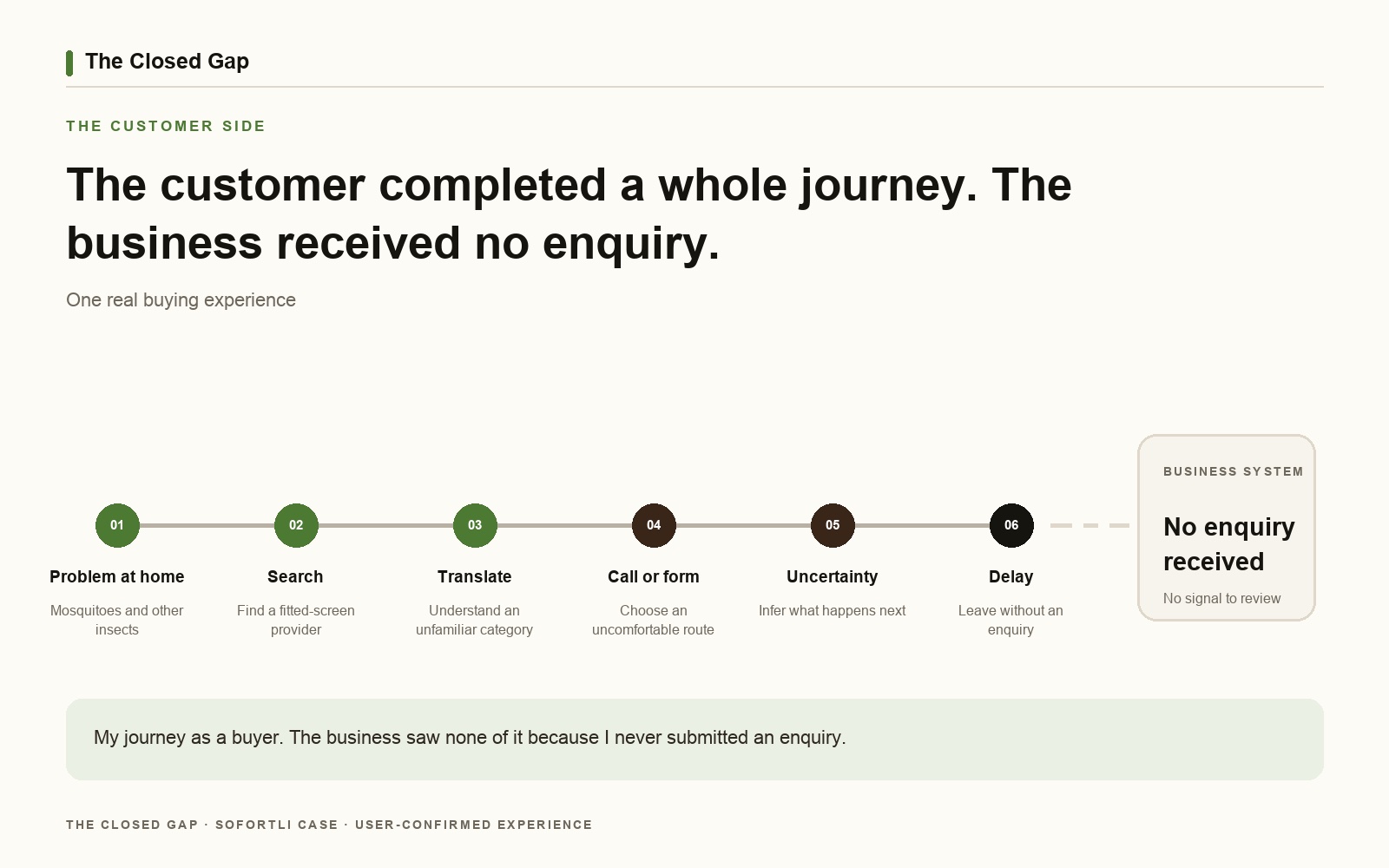
The information I found was mainly in German. I can navigate German, and I still prefer English when I am trying to understand an unfamiliar product and make a decision about my home. Translation solved the first layer. It did not tell me which type of screen would fit my windows and doors, what measurements mattered, which options were useful, or how much the whole thing might cost.
The journey kept leading me toward a phone call. That meant finding a gap between meetings, calling during business hours, and trying to explain windows, doors and insects using product vocabulary I did not have. I knew the result I wanted. I could not yet describe the product that would produce it.
There was a written enquiry route, and it opened another set of unknowns in my head. When would somebody answer? Would the answer become another phone call? How much detail was I expected to provide? Would requesting a quote create an expectation that I was already ready to accept it?
The business may have had perfectly reasonable answers to every one of those questions. I could not see them from where I was standing.
So I delayed.
The customer who never reached the inbox
From the business side, very little happened. The company received no enquiry from me. Its team had no call to return and no quote to follow up. Its pipeline continued as if I had never been there.
That is the part I keep turning over. Businesses can measure the enquiries they receive, the time taken to answer and the number of quotes that convert. Those measures begin after the customer has made themselves visible. My hesitation happened earlier, while I was still trying to work out whether I understood enough to continue.
A willing customer can disappear before the company receives a signal.
I call this invisible sales friction. The customer has a problem the business can solve, and uncertainty slows the journey before an enquiry exists. Nothing dramatic needs to happen. A phone call feels inconvenient. The product language feels too specialised. The next step carries an obligation the customer cannot judge. The tab stays open for a few days, and then everyday life takes over.
My experience also exposed a limitation in the way we often talk about customer personas. An owner may know current customers extremely well and still miss people who never enter the process. My situation brought together an expat’s language preference, a meeting-heavy working day and very little knowledge of the product category. The owner could not learn any of that from the enquiry data because I had supplied none.
One experience is evidence of one experience. Repetition would be needed before turning this pattern into a useful segment or persona. It is enough, however, to identify a customer moment worth investigating.
Building the alternative
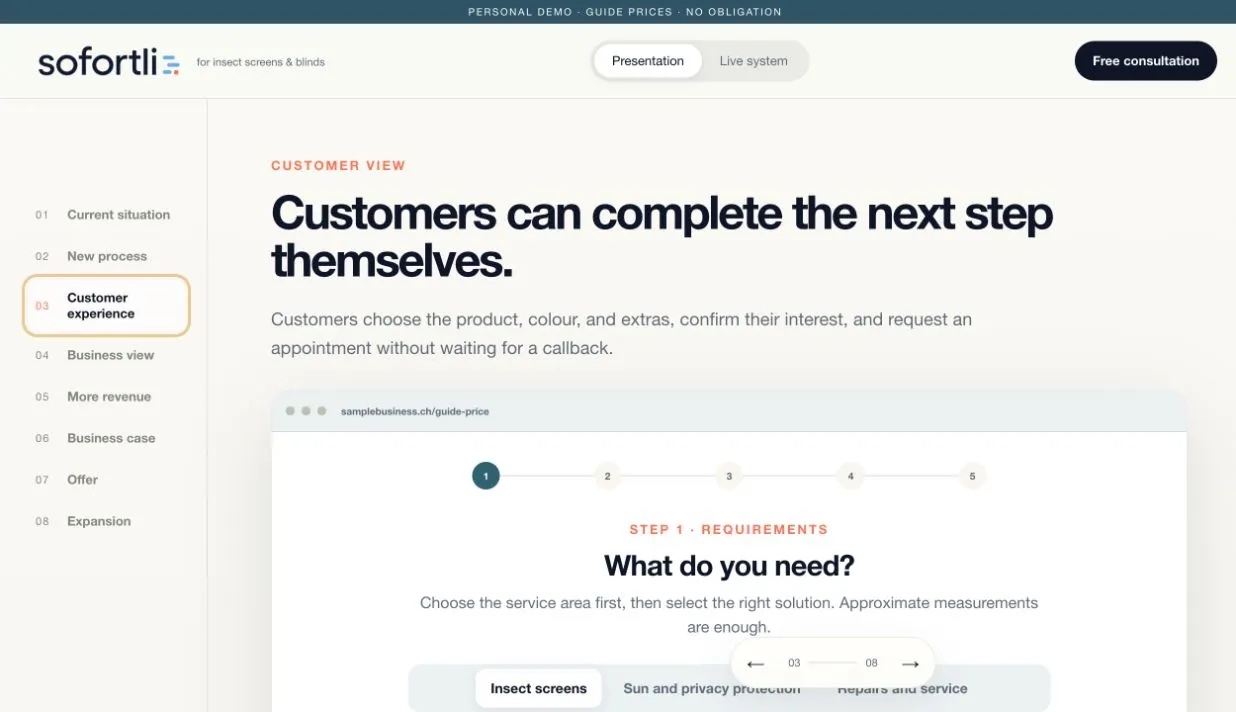
I used this experience to shape Sofortli, a working demonstration for Swiss insect-screen and blinds businesses that I built with Codex. I wanted to see what the journey could look like if the customer could begin with the problem in their own words and understand the path before speaking to anyone.
In the demonstration, the customer chooses a service area and explores relevant options. Approximate measurements are enough to begin, and photos can be used when measurements are unavailable. The customer sees a sample guide price, chooses how to continue and requests an appointment. The business receives a structured sample enquiry with the information collected during the journey.
Every person, price, enquiry and result inside the demonstration is sample data. The flow is working. Its use by real customers and businesses remains to be tested.
That distinction matters because a polished demonstration can create a false sense of evidence. Sofortli shows that the proposed interaction can be built and experienced. Customer adoption, price accuracy, integration requirements and commercial impact remain open questions.
The exact jobs for AI
The word AI can make this discussion foggy very quickly. I mapped the customer and commercial jobs first, then assigned the technology.
AI could help the customer express the problem in ordinary language, including a language the business does not normally use on its website. It could ask a different follow-up question depending on whether the person needs a window screen, a balcony-door solution or help identifying the product. It could explain unfamiliar options in plain language and create a concise, structured summary for the team.
Those are specific language and reasoning jobs:
understand a customer’s description without requiring specialist terminology;
clarify missing information through adaptive questions;
explain approved product information in the customer’s preferred language;
summarise the conversation into a structured enquiry for human review.
The guide price belongs to approved business rules. Availability belongs to the scheduling system. Confirmations and routing belong to automation. The final technical recommendation and binding quote should remain with the qualified person responsible for delivery.
This division makes the system more credible. AI handles language and synthesis. Business rules carry the numbers. Automation moves approved information between steps. A person owns the consequential decision.
AI without the journey and approved rules has very little useful work to do. Commercial design gives it a job.
Commercial logic comes first
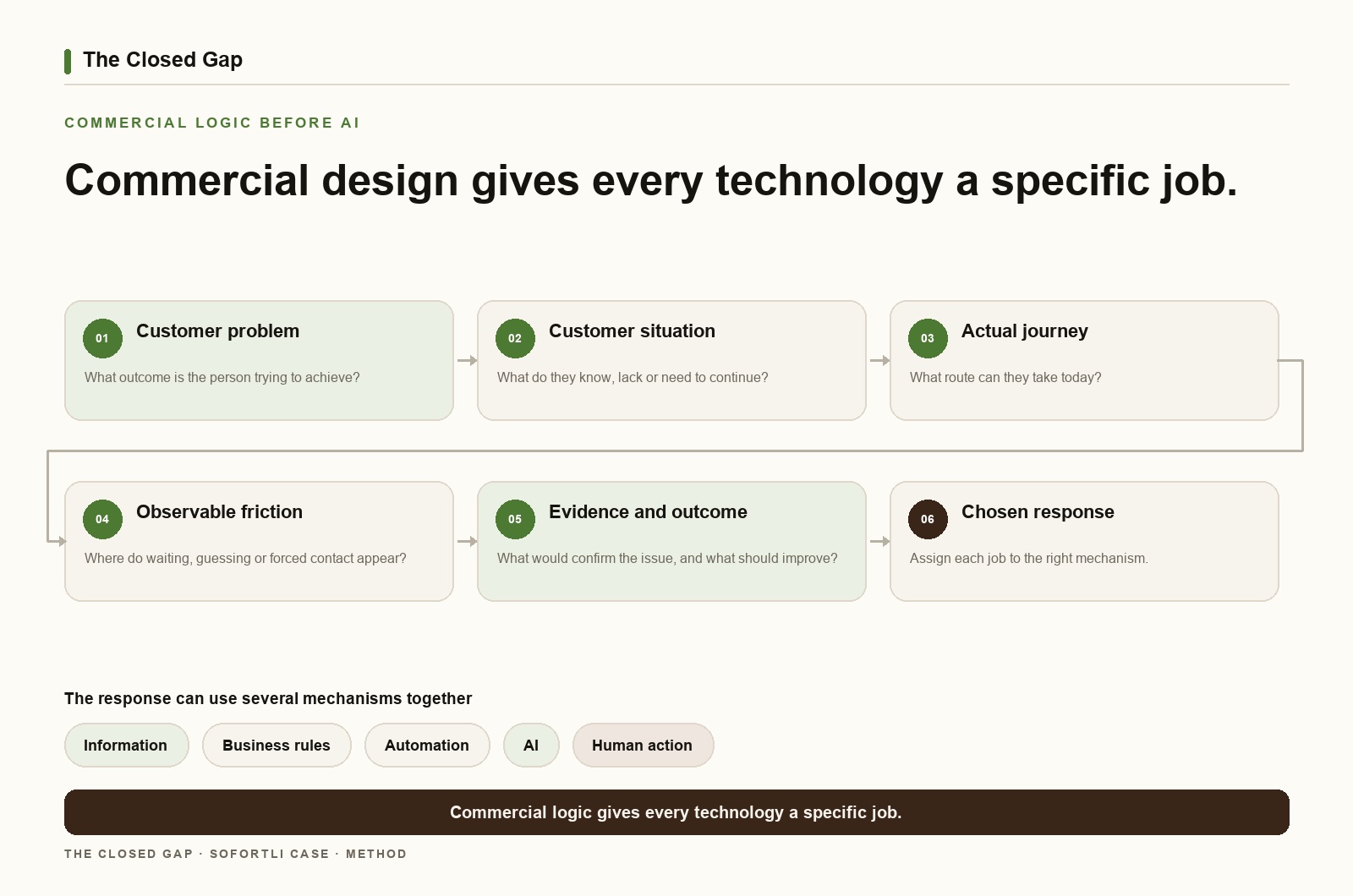
The underlying method is classical marketing and sales work. Start with the problem the customer brings. Walk through the journey that is publicly available. Mark the moments where the customer must wait, guess, translate, call or commit. Collect evidence. Decide what should improve. Then select the smallest useful response.
For my insect-screen journey, the sequence looks like this:
Customer problem: keep mosquitoes and other insects outside the apartment.
Customer situation: willing to buy, more comfortable in English, busy during calling hours and unfamiliar with the product category.
Observable journey: search, translate, consider a call or form, and try to infer what happens next.
Friction worth testing: uncertainty about the product, the interaction and the meaning of requesting a quote.
Desired customer outcome: understand the relevant option, an indicative range and the next step well enough to continue.
Chosen response: guided information, approved business rules, selective AI assistance, workflow automation and human technical review.
The sequence survives when the word AI is removed. That is a useful test. The customer, journey, evidence and commercial outcome still make sense, and the technology can be judged against a defined job.
What this case establishes
This case gives us a verified personal buying experience, a working demonstration, a practical method and a set of questions for real-world testing.
It gives us no market frequency, adoption rate, sales impact, validated pricing logic or evidence that an owner would pay for the system. Those questions require contact with real businesses and customers, with their consent and the correct permissions in place.
Keeping those claim states separate makes the case more useful. We can examine the journey without pretending the demonstration has already produced a commercial result.
And we can use the same method without building any technology at all. A business owner can open the public website on a phone, choose one realistic customer situation and follow the route as that person. The first useful output is one exact moment where the customer could become uncertain enough to wait, together with the evidence that would confirm or challenge the hypothesis.
The customer’s uncertainty has a mirror image inside the business. An incomplete enquiry transfers the missing work to the owner: clarify the need, collect dimensions, prepare a range, decide whether a visit is worth making, and eventually discover how serious the customer is. I will take that side of the journey next week.
Test one journey in your business
I have turned the method into a free Customer-Journey Test. It helps you document the problem the customer brings, the situation they are in, the route available today, one friction point worth investigating and the smallest response worth testing.
Download the worksheet from The Closed Gap and use it on one real journey. One customer moment that is specific enough to examine is a practical beginning.
If you find one, I would like to hear how you describe it. I am collecting the language people use for these moments, while keeping individual responses separate from broader market evidence.
The first question is simple: where could a willing customer become uncertain enough to wait?